From 'Kitab al-'Ayn' to 'Lisan al-'Arab': The Evolution of Arabic Dictionaries
Seebawayh Team
7/25/2026
#Arabic dictionaries#Lisan al-Arab#al-Khalil#lexicography#Shamela
Why Arabic Dictionaries Matter
Every serious Arabic student needs to know the classical dictionaries and their arrangement systems. Each dictionary embodies a different theory of how the language should be indexed.
The Milestones
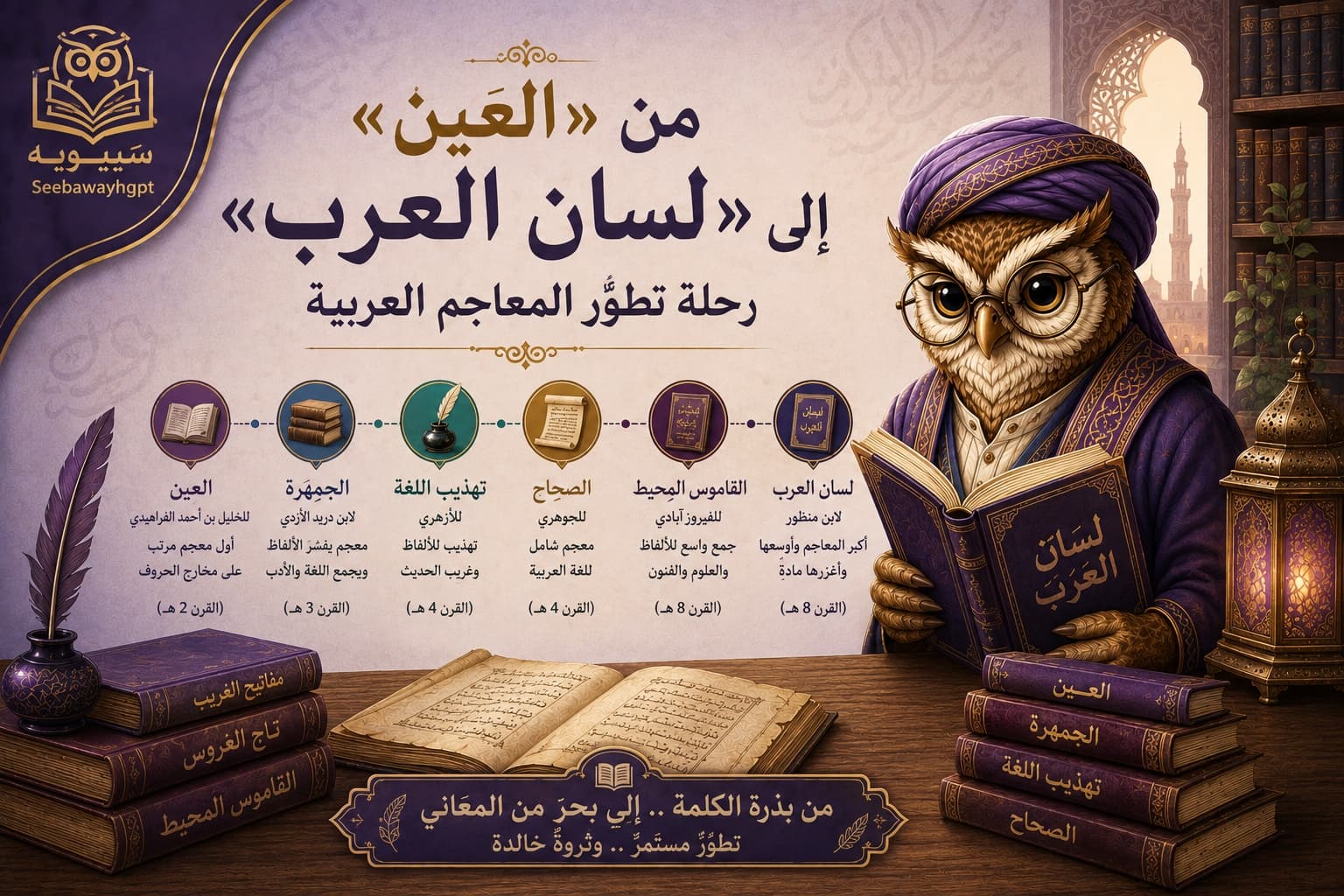
- Kitab al-'Ayn (al-Khalil ibn Ahmad, d. 170 AH): The first Arabic dictionary; arranged by phonetic points of articulation starting from the throat.
- Jamharat al-Lugha (Ibn Durayd, d. 321 AH): First to introduce alphabetical order by first letter.
- Al-Sihah (al-Jawhari, d. 393 AH): Sorted by the final letter, useful for rhyme-finding.
- Maqayis al-Lugha (Ibn Faris, d. 395 AH): Traces every root back to a single core meaning.
- Lisan al-'Arab (Ibn Manzur, d. 711 AH): The largest, most comprehensive Arabic dictionary ever compiled (~20 volumes).
- Al-Qamus al-Muhit (al-Fayruzabadi, d. 817 AH): So famous that qamus became the modern Arabic word for "dictionary."
- Taj al-'Arus (al-Zabidi, d. 1205 AH): A ~40-volume expansion of al-Qamus.
How to Use Them Today
- For broad meaning + citations: start with Lisan al-'Arab.
- For semantic depth: consult Maqayis al-Lugha.
- For rhyme lookup: use al-Sihah or al-Qamus.
- For automated grammatical analysis of any Arabic sentence: use Seebawayh's AI i'rab tool.
Read the full Arabic version: «من العين إلى لسان العرب»
Keywords: Arabic dictionaries, Lisan al-Arab, al-Qamus al-Muhit, al-Khalil, Arabic lexicography.