Dala'il al-I'jaz by al-Jurjani: The Theory of Nazm and the Foundation of Arabic Rhetoric

Seebawayh Team
8/3/2026
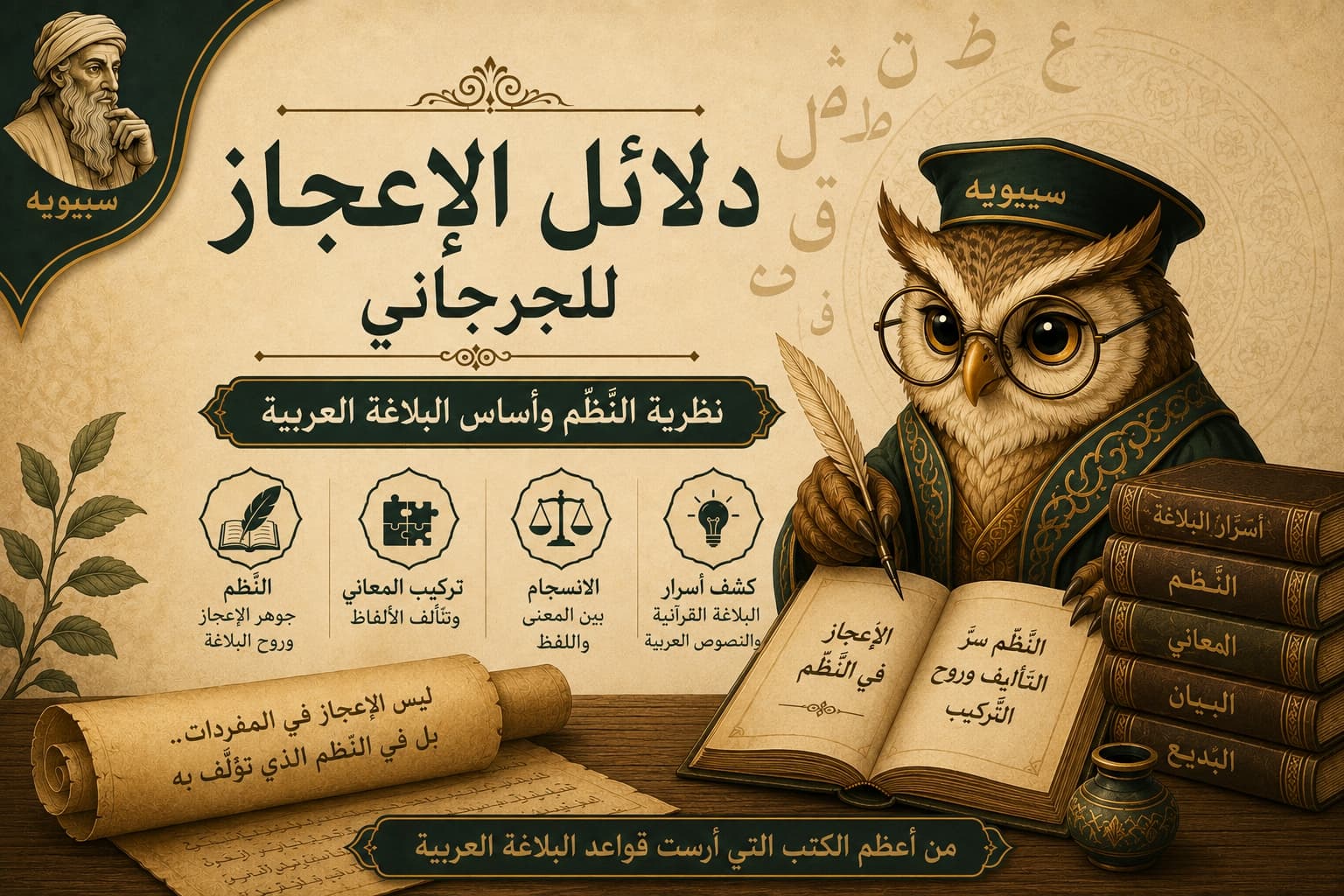
Who Was al-Jurjani?
'Abd al-Qahir ibn 'Abd al-Rahman al-Jurjani (400–471 AH) authored two revolutionary books that transformed the study of Arabic rhetoric (balagha):
- Dala'il al-I'jaz: founded 'ilm al-ma'ani (semantics of syntax).
- Asrar al-Balagha: founded 'ilm al-bayan (imagery).
The Problem He Solved
Why couldn't the eloquent Arabs match the Qur'an? Al-Jurjani's answer is elegant: the miracle is not in individual words but in the syntactic-semantic relationships between them; a theory he called nazm ("composition").
"You will not find a single instance whose correctness (if right) or error (if wrong) does not trace back to nazm."
This anticipates structuralist linguistics by nearly a millennium; words gain meaning only through their relationships to other words.
Evidence
Word order changes meaning
The Qur'anic verse innama yakhshallaha min 'ibadihi al-'ulama' places "God" (the object) before "the scholars" (the subject) to achieve restriction: only scholars truly fear God. Reversing the order would flatten the meaning.
Definiteness vs. indefiniteness
Wa ja'alna min al-ma'i kulla shay'in hayyin; the indefinite "hayyin" gives universal scope.
Al-Jurjani's Golden Line
"Words are the servants of meanings; meanings command and words obey."
This reversed the aesthetic tradition that had prized surface eloquence, redirecting focus to deep semantic-syntactic craft.
Study Path
- Read the introduction carefully.
- Focus on the chapter tafawut al-maziya (variance in eloquence).
- Parse each Qur'anic example: try Seebawayh's i'rab tool for rapid grammatical analysis before diving into rhetorical layers.
Read the full Arabic version: «دلائل الإعجاز للجرجاني»
Keywords: Dala'il al-I'jaz, al-Jurjani, theory of nazm, Arabic rhetoric, Qur'anic i'jaz.