The Sixteen Arabic Poetic Meters: Al-Khalil's Science of Prosody
Seebawayh Team
7/31/2026
#Arabic prosody#poetic meters#al-Khalil#arud#Arabic poetry
The Founder
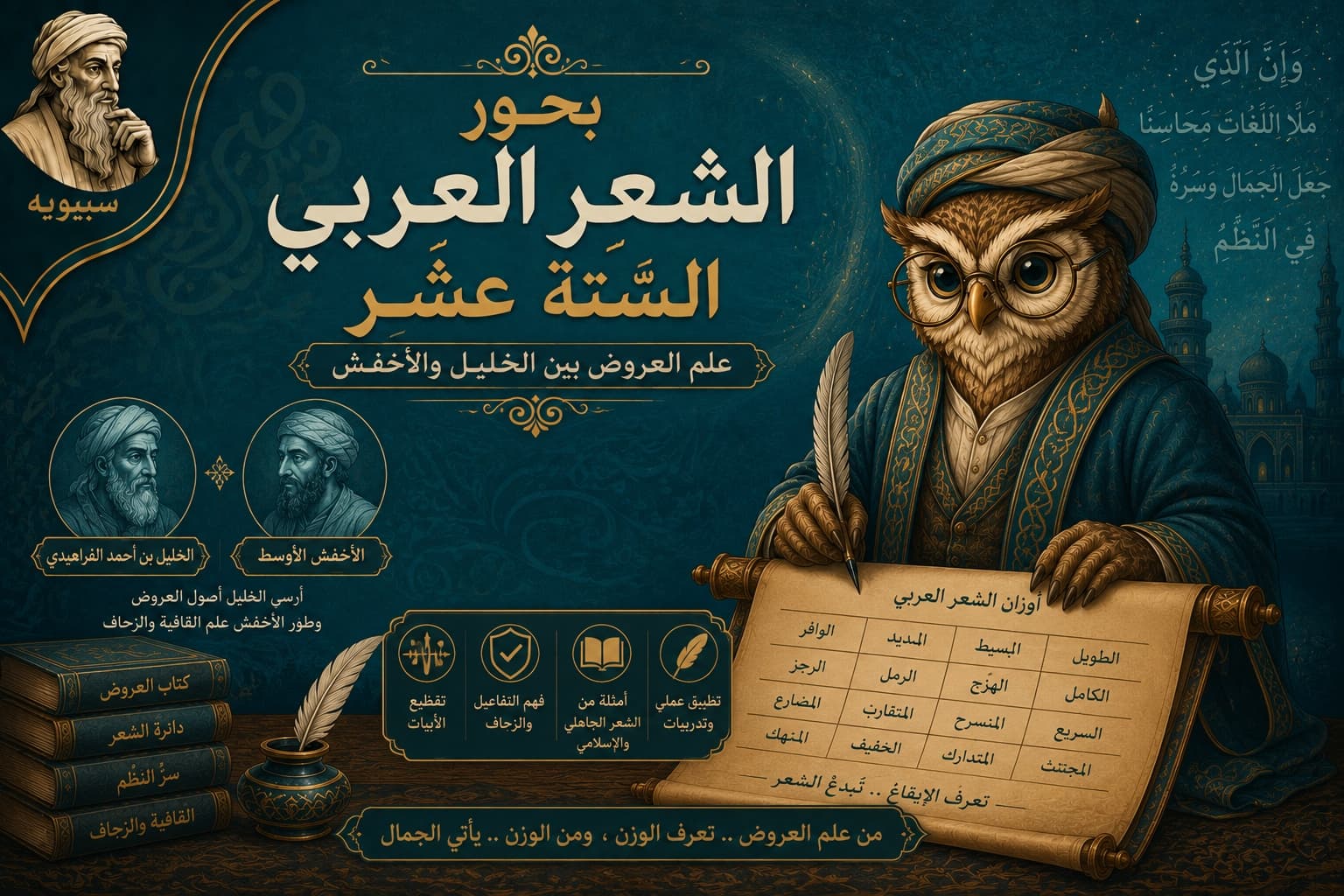
Al-Khalil ibn Ahmad al-Farahidi (100–170 AH), teacher of Sibawayh, invented Arabic prosody ('ilm al-'arud). Legend has it he conceived the theory while listening to the rhythmic clang of copper pots in a Meccan market.
The Basic Unit
Every line consists of a sadr (opening hemistich) and 'ajuz (closing hemistich), each built from taf'ilat; rhythmic feet like fa'ulun, mafa'ilun, mustaf'ilun, and fa'ilatun.
The 16 Meters
Al-Khalil enumerated 15 meters; his student al-Akhfash added the 16th (al-Mutadarak):
- al-Tawil: the noblest, most common (e.g., Imru' al-Qays's "Qifa nabki…")
- al-Madid: rare
- al-Basit: solid, ceremonial
- al-Wafir: powerful (Ahmad Shawqi's "Idha al-sha'bu…")
- al-Kamil: expressive
- al-Hazaj: song-like
- al-Rajaz: used for didactic poems (like the Alfiyya!)
- al-Ramal
- al-Sari'
- al-Munsarih
- al-Khafif
- al-Mudari': rare
- al-Muqtadab: rare
- al-Mujtathth
- al-Mutaqarib
- al-Mutadarak (added by al-Akhfash)
Why Learn Prosody Today
- Cultivates your poetic ear.
- Prevents you from writing broken-meter verse.
- Sharpens phonetic awareness.
- Assists in Qur'anic recitation rhythms.
- Provides context for parsing Arabic verse.
Read the full Arabic version: «بحور الشعر العربي الستة عشر»
Keywords: Arabic prosody, 16 poetic meters, al-Khalil ibn Ahmad, arud, Arabic poetry rhythm.