Talkhis al-Miftah by al-Qazwini: Your Concise Guide to the Three Sciences of Balagha

Seebawayh Team
8/4/2026
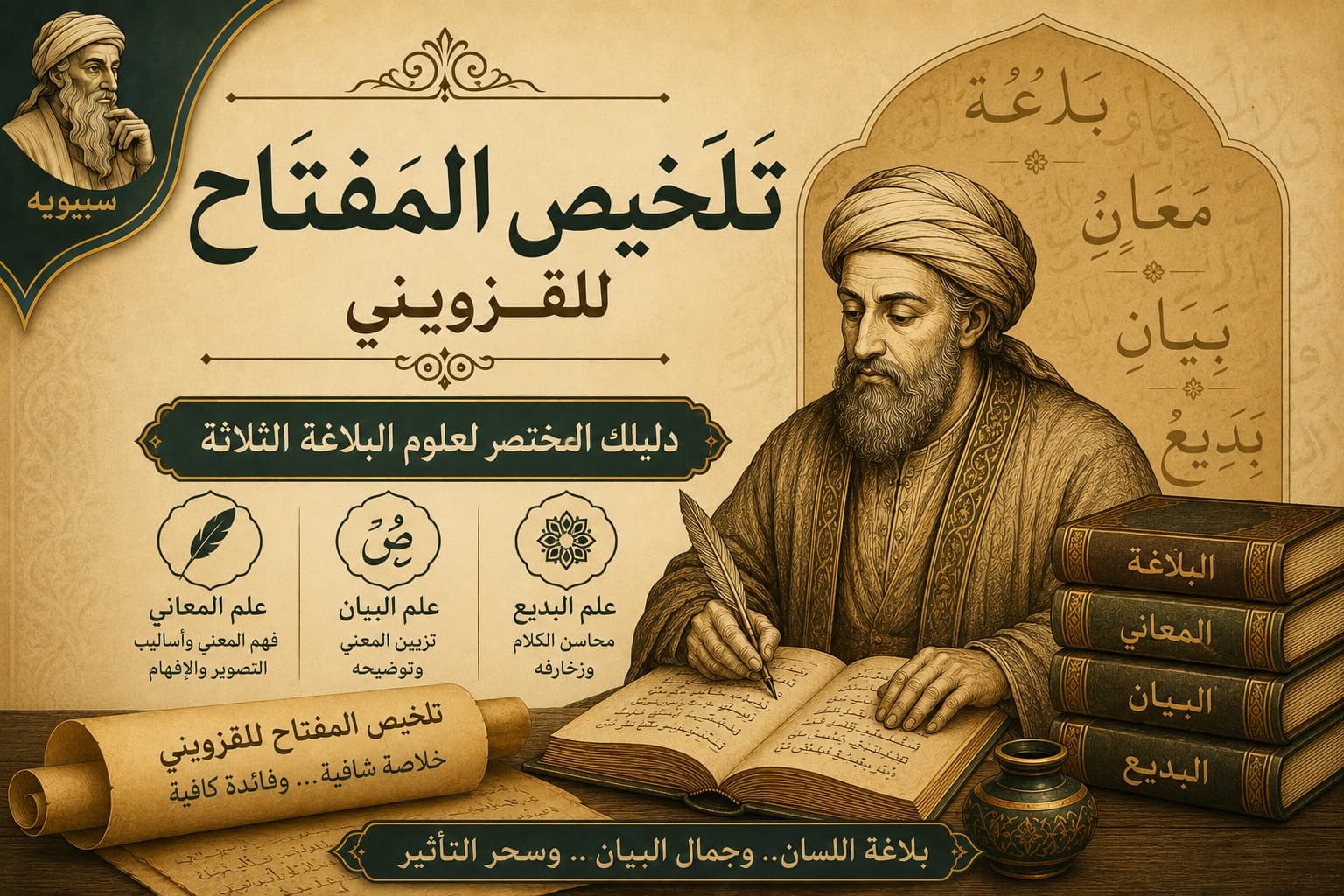
Al-Qazwini's Achievement
Jalal al-Din Muhammad al-Qazwini (666–739 AH) did not invent a new theory. Instead, he did something teachers dream of: he condensed al-Sakkaki's massive Miftah al-'Ulum into a tightly structured student text. That summary, Talkhis al-Miftah, became the standard rhetoric textbook for 700 years across the Islamic world.
The Three Sciences
1) 'Ilm al-Ma'ani (Semantics of Syntax)
How Arabic sentence structure changes meaning:
- Declarative vs. performative
- Definite vs. indefinite subject/predicate
- Word-order variation
- Qasr (restriction/exclusive focus)
- Wasl and fasl (when to conjoin/disjoin clauses)
- Ijaz, itnab, musawah (concision, expansion, equivalence)
2) 'Ilm al-Bayan (Imagery)
Different ways to express the same meaning:
- Tashbih (simile)
- Isti'ara (metaphor)
- Majaz (figurative reference)
- Kinaya (allusion)
3) 'Ilm al-Badi' (Rhetorical Ornament)
Enhancements after meaning and clarity are secured:
- Tibaq (antithesis), muqabala (parallelism)
- Tawriya (double entendre)
- Jinas (paronomasia)
- Saj' (rhymed prose)
Key Commentaries
- al-Mutawwal by al-Taftazani: the most famous.
- al-Mukhtasar by al-Taftazani: a shorter version.
- al-Idah by al-Qazwini himself.
- Hashiyat al-Dasuqi: the classic super-commentary.
Why It Still Matters
Taught today at al-Azhar, the Islamic University of Madinah, Dar al-'Ulum in Cairo, and rhetoric departments across the Arab world. Every serious student of Arabic literature passes through Talkhis al-Miftah at some point.
Combine your rhetorical study with live Arabic grammar analysis; because balagha rests on i'rab.
Read the full Arabic version: «تلخيص المفتاح للقزويني»
Keywords: Talkhis al-Miftah, al-Qazwini, Arabic rhetoric, ilm al-bayan, ilm al-ma'ani, ilm al-badi.